
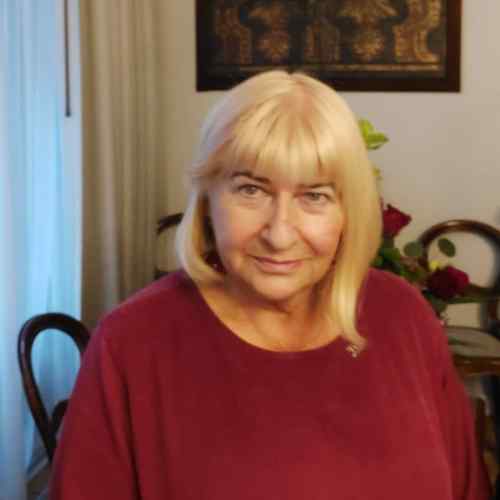
Elżbieta Ficowska
– social activist, educator, author of children’s books
interviewed by: Agnieszka Modrzejewska and Sylwester Kurowski
Translation: Zuzanna Czachowska
Fate Encased in a Spoon
As a child of the war, what do you think about the current situation in Europe, in Ukraine, and in our homeland? Can we feel safe?
I don’t feel threatened, but I am a realist and I know that when you are dealing with a madman, you never know what will happen. If it were possible to conquer Ukraine, then it could go further. But then Russia would pick a fight with NATO. I don’t want to pretend to be an expert, because I’m not, but I’m not sure if it’s a good thing that the West is holding back its help, because people are dying there every day. That would be the main reason to intervene. They are afraid of a nuclear war, afraid to get involved so that it doesn’t turn against them. I also think they are afraid of a third war, but in fact, the third war has already begun. Ukrainians are dying not only for Ukraine, but also for the rest of Europe, though not everyone fully realizes that. On the other hand, the Polish reaction, their help and engagement, is absolutely beautiful. My heart swells when I see it. But I also admit that I am a bit worried whether their enthusiasm and empathy will last, because it comes in waves—I already hear different voices and opinions on the subject.
Actually, these two wars are difficult to compare, because during World War II, the situation was such that Jews were sentenced to death just for being Jews. If they showed themselves, they were immediately killed. Of course, it was war, and people died in war: Jews and non-Jews. But non-Jews could move around, work, under restrictions and many limitations, but they could somehow live. Of course, they died, as happens in war, but not just because of who they were. Jews had to hide under floors, in basements, and this applied to both adults and children. If it turned out that they were Jews, they lost their lives, as did those who helped them. So fortunately, it’s not like that now, but it’s still very bad, it’s terrible. Putin attacked the Ukrainians without any real pretext. There was nothing to indicate he would do it. He is a madman.
As for refugees. People after such trauma—I say this as someone who studied pedagogy with psychology—have the right to various reactions. Sometimes a person closes in on themselves, is even aggressive, doesn’t want to speak, is sullen, withdrawn. And those who rescue them, invite them, host them, expect guests who are smiling, who will show them Warsaw, go with them to Łazienki Park, and that they will be grateful, but suddenly the man or woman is sulking and barely speaks or doesn’t speak at all. Some may treat it as black ingratitude, because no one told them that such reactions are possible, no one prepared them for that. Moreover, I think that in this very beautiful surge there is also a bit of a reaction to the other border, the one with Belarus, because we still get messages that people are dying there, freezing to death. So, how are these people different from those people, why don’t we help those others? There are various arguments, for example, that it’s economic migration…
The government doesn’t allow helping at one border, but at the other it gave permission for full help, so everyone rushed to help, feeling that in this way they are, as it were, making up for their guilt towards those who were dying at the other border, or are still dying. It’s terribly sad, because at the other border there are the same people who found themselves in a hopeless situation. Because if they are not let in from one side, and not from the other, and they are in the middle, regardless of what led them there, they were deceived, but they are still people. For God’s sake, we cannot let them die there. So, I think that what we are doing for Ukrainians is also a kind of reaction. Only, I hope it doesn’t turn against those we want to help.
Where did the diminutive of your name come from, not the obvious and common ones like Elżunia, Elżbietka, Elunia, but Bieta?
It’s not even a diminutive, simply when I went to school, Elżbieta was fashionable and there were about six or seven of us with that name in the class. We had to be called something to distinguish us. And Bieta is just the ending of the name. That’s the whole mystery.
Apart from being an extremely charismatic, socially engaged person and, let’s be honest, simply beautiful, you also have an extraordinary voice: low, slightly nasal, with excellent diction. A voice that makes it not only pleasant to listen to what you say, but also how you say it. Can a voice be an asset, and have you ever thought about an artistic career that would highlight it? Actress, radio announcer?
I completed postgraduate acting studies at the Polish Theatre. For some time, I also performed on the stage of the Jewish Theatre, and apparently I did quite well, but when I had a child, I no longer had time for it.
Is it easy for you to answer the question of whether you are the daughter of Henryka Koppel, who gave birth to you, or Stanisława Bussoldowa, who raised you?
I was torn from my Jewish roots so early that I didn’t have time to build my Jewish identity, so I don’t feel Jewish.But the best answer to this question is a poem by my husband, Jerzy Ficowski, titled “Both My Mothers”.
Under the futile Torah
under the imprisoned star
a mother gave you birth
you have proof of her
unanswered unkilled
the scar of your navel
the mark of parting forever
which didn’t have time to hurt you
you know this
Then you slept in a bundle
carried out of the ghetto
someone said in a box
cobbled together somewhere on Nowolipie
with a supply of air
without a supply of fear
hidden in a cart full of bricks
You slipped out in that little coffin
saved by stealth
from that world into this world
all the way to the Aryan side
and fire took
the empty corner left by you
So you did not cry
crying could be deadly
luminal lulled you
with its lullaby
And you almost weren’t
so that you could be
And your mother
saved in you
could now join the crowded death
happy but incomplete
could give you instead of memory
at the parting
a resemblance to herself
and a date and a name
just that much
And soon someone
busied themselves around your sleep
someone passing by in haste
and stayed for a long forever
and washed you of orphanhood
and wrapped you in love
and became the answer
to your first word
These are both your mothers
who taught you
not to be surprised at all
when you say
I a m
You cannot remember anything from that time spent in the ghetto, because you were only a six-month-old baby, but let’s recall your extraordinary story…
Paweł Bussold, my mother’s stepson, took me, a tiny baby, sedated with Luminal so I wouldn’t cry during the journey, out of the Warsaw Ghetto. He transported me in a wooden box under a pile of bricks to the Aryan side, where Stanisława Bussoldowa took care of me. Until I was seventeen, I considered her my only mother.
What kind of child were you? And how did learning the true story of your origins affect you?
I was a terribly spoiled brat. For example, at school, if something didn’t suit me, I would sulk and turn my back to the class. I was allowed everything and it never occurred to me that it might not be proper. At home, there wasn’t a situation where I didn’t get what I wanted. I was a monster, an incredibly pampered brat—spoiled by my mother, her adult children, and my nanny.
From the moment I learned to walk, I would sulk and run away. In Michalin, where I lived with my nanny, I had a beloved doll that I always carried under my arm and a little suitcase with her clothes and a potty. I never went anywhere without them. Later, I continued to run away from home.
I think the news that fell into my lap made me reflect, and I’m not sure if that reflection would have come under other circumstances. That news was certainly a milestone in my life.
How did you find out your true story and learn about your origins?
The first hints appeared quite early, but I didn’t pay them much attention. For example, when I was with my mother at Bródno Cemetery at the grave of her husband, whom I considered my father, I noticed a discrepancy: he died in 1940, but I was born in 1942. I asked my mother how that was possible, and she briskly replied that it was the stonemason’s fault for supposedly mixing up the date on the plaque, and so it remained. I believed her and didn’t pursue it.
There are anecdotes about mistakes and chaotic situations among craftsmen and artists… But returning to my story, it didn’t even strike me as odd that when Stanisława Bussoldowa took me in, she was nearly sixty and could have been my grandmother rather than my mother. But she was very well-groomed and looked young for her age, so it didn’t make me think.
It was only when a school friend asked me why I hadn’t told her I was Jewish that I first tapped my forehead and told her not to talk nonsense, but then I started to connect the dots, ask questions, search, and dig deeper…
What does the famous spoon mean to you, the one that was with you when you left the ghetto? Is it more of a relic, a keepsake, a birth certificate, or a kind of burden?
That spoon is for me a link between myself and a world I never got to see or know. It is my birth certificate. My name and date of birth are engraved on it. Many Jewish children had fake birth certificates; they don’t know when they were really born. I know. Thanks to that spoon, when I celebrated my eightieth birthday in January, I had certainty and proof that this is really true.
It is also the only keepsake I have from my biological parents, who died in the Warsaw Ghetto—my father in the ghetto, my mother in the Poniatowa camp. Apart from the spoon, I have nothing else, no photos or mementos from that period. Everything was lost in the ghetto. The spoon is also a kind of talisman, and I am convinced it brings me luck. Not just to me, but also to my daughter and grandchildren…
There is also another important spoon, which my husband ordered for me for our wedding anniversary. So now there are two spoons.
Let’s go back to your infancy. Was it that Stanisława saw this tiny, probably beautiful little creature and fell in love with the baby and decided to keep the child, or did she already have the idea to take in a child and give it a home, and it just happened to be you?
No, she didn’t have such an idea. She was looking for safe places for the children she rescued and who came to her foster home. If a child was older and spoke only Yiddish, for example, she had to prepare them: teach them to speak Polish and teach them the Lord’s Prayer—that was the first thing. Because if a blackmailer stopped them on the street and said, “Cross yourself,” and the child couldn’t do it, it was clear it was a Jewish child.
There was already a place waiting for me with a poor woman in Praga, but my mother had the habit of checking out these places before giving children away. She found out that the woman was sick with tuberculosis, which was incurable at the time. She said, “I won’t give this child away.” And she decided to keep me herself. She was a widow at the time, living alone, her children were already grown and independent. Her daughter was in Austria, her son had started his own family and had a son. Her husband, her second one, had died in 1940, and I appeared in 1942. Nevertheless, in my birth certificate, he is listed as my father. To this day, it is my current and only birth certificate. I don’t change it—why should I?
Once you said you felt like God’s favorite, a lucky person. Do you still see yourself that way?
Of course. In everything, you have to have luck, and I am convinced that I have it. This way of thinking also helps a lot. It often works on the subconscious. I don’t know if you’ve noticed, but there are people who keep saying that nothing works out for them, that they have bad luck, that they aren’t lucky. And indeed, nothing works out for them, everything goes wrong. But to some extent, they bring it on themselves. For me, it’s the opposite. A long time ago, I came across a book by a pair of American psychologists, the title was “Emotional Intelligence,” and they mentioned how important attitude is in everything you do.
What fascinated you about boarding schools for young ladies, that you wanted so much to study there?
I read a lot of books about boarding school girls in my childhood. There was an author named Lidia Czarska, and she wrote books about boarding school girls that I really liked, and I wanted to be at a boarding school. Since there were no longer boarding schools in People’s Poland, but there were still some private schools with dormitories, mainly run by nuns, I decided to stay there. Basically, they were run on the model of pre-war boarding schools. They taught girls good manners, piano, and so on. Besides, these schools were at a very high level, because they had to stand out positively so that they wouldn’t be closed. The nuns had to have arguments. And I really wanted to be at such a school, and if I wanted something, I got it. These were very expensive schools, I remember that my mother paid 1,200 or 1,400 zlotys a month, which was a lot.
Actually, the nuns eventually expelled me from the school because I didn’t fit in. I walked on my hands, slid down banisters—for the nuns, that was too much… But I don’t regret going there, it was a special, nice time.
Young ladies can be exalted, so one day I came home and told my mother I would probably become a nun. She was scared, so when the nuns expelled me, she sighed with relief and was happy.
Who was the poet Barbara Sadowska, mother of Grzegorz Przemyk, to you? What was she like?
Basia Sadowska was a great friend of mine, the mother of Grzesiek Przemyk, an excellent poet, she lived on Hübnera Street, right in the center of the city, in a high-rise. Her apartment was never locked. Anyone could drop in at any time of day or night. Usually, there were a dozen or so people sitting there. Someone had just gotten out of prison, someone else came by for something, and they all sat on the floor with a guitar and sang subversive songs. There was a very relaxed atmosphere.
When Basia was in Rakowiecka prison, I really wanted to get her out, because she had just had a serious brain operation, had a platinum plate in her skull, and was not fit for the harsh conditions there. So I went to attorney Aniela Steinsbergowa, who, although not young anymore, was still involved. She was a very distinguished person, one of the co-founders of the Committee for the Defense of Workers. I went to her and asked, “Aniela, what should I do? I have to go to the prison warden right away to get Basia released!” She smiled and said, “Listen, you can’t, because you have to write a petition, and they have two or three weeks to respond. If you want to give a package, you also have to write a petition. They allow it, but you have to wait.” She said it couldn’t be done any other way. But I managed. I went home and thought about how to get in as quickly as possible, not in two or three weeks. Then I remembered that my husband had made me business cards for my birthday, with all my affiliations: to ZAKR, to ZAIKS, that I was a master’s graduate in pedagogy, and so on. I once asked him what I was supposed to do with them and who to give them to. He answered mischievously that they were so I would know I was an adult. This coincided with the TV broadcast of a series about Arsène Lupin—a gentleman burglar who left his business card at the scene of the crime. The next day, I called Grzesiek Przemyk, and he prepared some things for Basia. We made a package, which I put in the trunk of my Fiat 125p, took my business card, dressed up as a lady, and went. I drove up to Rakowiecka prison and was stopped. I wondered how to get in, and suddenly, as if on cue, a delivery truck with food arrived at the prison. It blocked the gate, leaving only a small gap, and I slipped through. I went straight to the permits office, threw in my business card like Arsène Lupin, and said I urgently wanted to speak to the warden. The woman there looked at me, looked at the card, and didn’t understand anything. Everyone who came there apologized for existing, and here suddenly someone was breaking the convention. She reacted positively, said, “Please wait, I’ll go to the warden.” I thought, “Now I’m in trouble.” But the warden reacted similarly. He put my card on his desk and invited me in. I told him what was going on, that a doctor had to come, here is a certificate from the hospital. He was incredibly angry, but it didn’t help. I played my part to the end, and leaving his office, I said, “Since I’m here, please make sure they accept a package for Ms. Sadowska from me.” He was furious, but he picked up the phone and called downstairs, saying, “Accept a package from the lady.” Only, the package was in the trunk of my Fiat outside the gate. I thought, if I leave, they won’t let me in again. So on my way out, I told the man at the desk, next to the policeman, that the warden had just called to accept a package from me, but it’s heavy, so could someone help me? He called someone, “Go! Bring the lady’s package.” He came out with me. I got in the car, opened the trunk, and he took out the package, and we went back together. It worked, and I went straight from there to Aniela Steinsbergowa to tell her everything. She listened and said that from now on she knows that where the devil can’t, she should send me. And that she would never have believed it would work.
And what about the doctor? Did they call him?
He promised me, yes, because it was a serious matter.
Did you know each other from KOR or earlier?
No, we were friends before.
Why do you think her poetry has been forgotten? Why is it not reprinted, not published? I studied Polish philology, and we discussed many things from the 1980s, for example, Father Popiełuszko’s sermons, but there was never any mention of Sadowska’s poetry. Even though philologists should know her work…
Of course, they should. When I look at the writers of my husband’s generation, there is no one to take care of it. Basia was much younger, but there is no one who cares. Just as in the case of Jerzy Ficowski, I and my daughter, who is the president of the Jerzy Ficowski Foundation, really do a lot so that he is not forgotten. Since he died, twenty of his books have been published. So we do it because we really care. If someone doesn’t leave anyone who cares, then that’s how it is. I believe that true greatness will defend itself and probably reveal itself in time.
People do return to valuable poetry, they look for it, but in the case of Sadowska, there is also a problem with copyrights?
Yes, there is a problem because Basia bequeathed the rights to Marzenka [née Urban], who was Grzesiek’s girlfriend, and it’s hard to reach an agreement with her. Many people have already complained.
…That’s a shame.
It’s a shame, but I really did what I could for many years: a foundation in her name was established at my initiative…
…and an award.
…and an award, yes, yes. So something was happening for a while, but then it stopped. Maybe someone young and energetic will take it up. Maybe…
Your grandchildren call you “Grandma” and compare your story to the one from Harry Potter, whose parents were murdered by a bad man. What kind of grandmother are you, and what are your grandchildren like?
Like every grandmother, I think my grandchildren are absolutely brilliant. I have three: the oldest, Filip, is 27. He first graduated in finance from WSH, then law at Kozminski University, of course with awards and distinctions. Now he works and is highly valued there, he knows several languages well, is very talented, and likes his job. His younger brother, Karol, has just turned 24 and is completely different. He’s a typical artist. While the older one is very organized, everything has its place and he knows exactly where everything is, the younger one loses everything and forgets everything. But he’s also a genius. He graduated in philosophy and is now studying two sociology departments. I didn’t even know there was a completely separate new digital sociology department. Karol applied for both traditional and digital sociology. He got into both and had a problem choosing, so in the end he’s studying both in parallel. And he’s great at it. When he finishes, he’s thinking about directing, and I think he’ll do it really well because he’s very versatile. And he’s the best cook in the family… His father also cooks well, but Karol is probably better. That’s also an art… My youngest granddaughter is called Lili and is 12… And she’s a communist, because she thinks it would be fairest if everyone had the same and the same amount, everyone equally. We’ll see what comes of her. My husband always said that if someone wasn’t left-wing in their youth, he wouldn’t grow up to be a decent person. So there’s potential.
Let’s also say who your daughter is…
My daughter Anna is a psychologist, she has aged terribly—on March 16, she turned 53. I can’t believe it. She’s a very good psychologist. She worked for quite a long time at Okęcie with air traffic controllers, which is a very responsible and stressful job, but they were very sorry when she decided to leave. She decided to leave when she had a daughter. The boys were already grown up, and then a Kinder surprise, but she said she wasn’t going to have a third child at such a mature age just to hand it over to a nanny. She never went back to work, cooks soups for the children… but I have to say it makes sense. I looked at her with admiration, because people her age want to make a career at all costs, and that’s what’s most important to them. My eighty years of life experience (and that’s nothing to sneeze at) tell me that what is really most important is family. It’s much more important than a career, and I looked at her with admiration that she gave it up for her family. But I see the results: even though the boys already live on their own, they visit their parents almost every day. They have dinner together, tell each other what’s new… it’s extraordinary. And they all love each other very much. I think this is the result of the fact that this home is a real home, a home where there is love, care, and home-cooked food. When they come, they know there will be dinner, that they can get something tasty. It’s not like someone didn’t have time and the fridge is empty. No, no… everything is as it should be. A real, well-ordered home. And I have to say, I really like it. I think this is really the most important thing. Because if you put all your energy into your career, the time comes when you retire and your career is over, and you have no children, or no bond with your children, or your children are already grown up and on the sidelines. It’s not worth it…
What was love like in your life? Let’s talk about your husband, the outstanding poet Jerzy Ficowski. Was it friendship at first, or love at first sight? And how did you deal with his lack of practicality?
I received an enormous amount of love in my life, very much. I think you could have given it to a whole regiment, and it pays off throughout life. That’s the greatest treasure and the best dowry you can get. I was surrounded by love from all sides: from my mother, from her adult children, from my nanny, from my husband, and from friends, and that’s important, very important. And that’s a lot, and when you get a lot, you have something to give. If a person doesn’t get love, has a deficit of feelings, then he has nothing to give. So it pays off…
From childhood, I had a tendency to run away, I was always being driven somewhere, I ran away from home. And it was during one of these escapes that I met my husband. A friend introduced me in the Writers’ Union café. He was terribly interested in my situation. He even asked me if I was hungry. I said yes. At the time, there was a writers’ canteen downstairs and a café upstairs, and he went down with me and fed me.
For a long time, he was a kind of substitute father for me. He was very caring and warm. The last thing I would have thought at the time was that he would be my husband. Besides, I didn’t want to have a husband. I only dreamed of having a daughter, but I didn’t want a husband.
My husband was extremely impractical. Once, when I came home from the store with pillows I had just bought, he was very surprised that you buy pillows, because in his opinion, pillows just exist at home.
My husband was a completely fantastic person and a great authority for me. I owe him a lot in terms of personality and worldview. He never did anything for convenience, absolutely. In those days, if you wanted to do something, you joined the party, but not my husband. He would never join the party for anything in the world.
When asked if he was a Jew or a Gypsy, he answered: if they beat Gypsies, then I’m a Gypsy; if they beat Jews, then I’m a Jew. He always stood on the side of the weaker.
Now he would probably feel Ukrainian.
Yes, although that took courage.
There was a time when we had a small child and had almost no money, because the communist authorities decided, without a court order (there were all sorts of kangaroo courts), that the name Ficowski could not appear in print anywhere. So my husband told me, “Listen, I’m very sorry, but the only thing I know how to do is write. I can’t earn money any other way.” Besides, he was physically quite frail. He wasn’t the type who could go and work as a porter. Moreover, he survived the Warsaw Uprising. He fought, survived a German camp, and had already been through a lot and wasn’t physically strong. I was young and strong, so I was the one who earned money by cleaning when necessary. I wasn’t very good at it, but you had to do something. Later, I went to America and cleaned there too.
Who was your adoptive American grandfather? And was he the only person from your family who survived the war?
He was the brother of my grandfather. He survived because he wasn’t in Poland. He ran away from home when he was twelve, maybe twelve. I don’t remember exactly how old he was, and he himself didn’t know, because he ran away as a child without any documents. He ran away to the States before the war and thus survived. So apparently, we have this running away in our genes. But apart from him, a cousin also survived, who was my mother’s cousin. He studied medicine in Paris before the war and came to the country for vacation, where the war caught him. He got married. He had a very beautiful and intelligent wife, both very young when they got married. They managed to survive. His father, who was a very wealthy man, somehow bought them out. And they left Poland in 1946. First to Sweden, then to the States, and they knew where I was. There are even photos from that time. My mother always resented that they knew where I was and after leaving, they never asked if the child had something to eat, if she was doing well… and they didn’t ask because they wanted to cut themselves off from the past, they didn’t want to go back to it, they didn’t want to remember. Later, I found them, it was in 1977. I was in the States for the first time and I found them. And I visited that grandfather’s brother. I bought a car for a hundred and twenty dollars, a Ford Capri without brakes… haha, and I drove around America. I had a lot of wonderful adventures, but I have to say that if I had gone there with money in my pocket and could have afforded to stay in hotels, and not buy a car for a hundred and twenty dollars without brakes, I wouldn’t have seen as much and it wouldn’t have been as much fun.
The adventure of a lifetime…
Oh yes, one big adventure.
Once in an interview, you said that a person is not born a hero, and even that heroism is a kind of pathology. So where does the need to help others, even at the cost of life, come from in a person?
Current historical policy tells us that it’s enough to be Polish to be the most important, the good one. You don’t have to have anything in your head, it’s enough to be born Polish, because Poles are a nation of heroes. Going back to history, of course, everyone rescued Jews. When I meet children, young people, and they ask me about it, I answer that Poles are the same nation as any other in the world, and as in every nation, there are good and bad people, smart and stupid. The same goes for Poles. And my story is a perfect illustration of that. My heroic mother, who rescued a lot of people, adults and children, when she decided to keep this six-month-old baby herself, and at the time she lived in Warsaw, had her own tenement house in Targówek, and this baby was with her for a while, the caretaker’s daughter together with some other neighbors started whispering that it was probably a Jewish brat, and that they should tell the Germans. My mother heard about it or somehow found out and immediately hid me.
Of course, my mother’s stepson, who took me out of the ghetto in a wooden box under a pile of bricks, and Irena Sendlerowa, who rescued—of course, not alone, as I always emphasize—over two thousand children, and my adoptive mother, also showed great courage. But that doesn’t mean everyone was a hero.
On our way to you, we wondered why you haven’t published your books for a long time? After all, you’ve written several.
Maybe because I have other things to do. Besides, I don’t consider myself a writer. I wrote various things, that’s true, but the real writer was my husband, and I… Two writers in one family is too much.
Especially since Jerzy Ficowski was a writer of great caliber. Really, and I say this not because he was my husband, but because that’s just the way it is. What I wrote were first bedtime stories for my daughter. I told her these stories, and each time it had to be a different story. I couldn’t repeat myself, because she remembered everything. One day I thought to myself that it was a waste, that I should write them down. And so I started publishing: I published one, two, three children’s books. They’re out there somewhere, but I didn’t attach much importance to them. I went with Ania to the theater. When we went to the children’s theater, she once asked me to write a play especially for her. God, how I struggled, I didn’t know how to do it. But I finally wrote it. After I wrote one, I wrote a few more. They were performed and even enjoyed great success. Then I wrote word-musical fairy tales for records. Recorded on records: first those big vinyl ones, then cassette tapes, and finally small CDs. My fairy tales still sell, and I wrote quite a few.
Whenever I wrote anything, I always did so under my maiden name, Bussold, never Ficowska. When I wrote my first children’s book, I went to the publisher, I think it was Interpress, and said my name was Elżbieta Bussold, and that I had written a children’s book, but I didn’t have a phone, I lived outside Warsaw, and I asked when I should come back to find out if anything would come of it. I was terrified that they would associate me with my husband, because either they would take it because of Ficowska, or I would embarrass my husband. Both cases were bad. So from then on, whatever I did literarily, I presented myself with my maiden name, including all the song lyrics I wrote. I wrote quite a few fairy tales. If you type “Elżbieta Bussold fairy tales for children” on Allegro, a few will pop up, they’re still out there.
How did your adventure with writing begin?
I started creating, probably like most teenage girls, by writing poems. I had a friend in high school, and one day she took me to the poet Swen Czachorowski. I don’t know if you know, but there was such a poet, quite good. Swen Czachorowski was very good friends with Białoszewski. They were even a couple for a long time, very much in love, and then when they started to hate each other, it was the end of the world… That’s how it often is with love… But she [my friend] took me to Swen, and it was a very special place. Swen Czachorowski lived on Bracka Street 5, in an old tenement with a courtyard and a well. He had a dark, small apartment. When I went there for the first time, I saw a dog and two cats. Swen was lying on the bed, had a nervous tic, kept throwing his head back. He took psychodrine and wrote poems, and his wife, Hania Wolska, who was the daughter of a famous mathematics professor, loved him very much. She was with him at the time, made clay brooches and sold them, because they were penniless. She also went with pots to the Writers’ Union canteen, from where she brought Swen his meals. And if a boy came to Swen, she had to leave, no matter the weather. She would go out, and if he tied a ribbon on the doorknob on the other side, she could come back in. She would walk around and couldn’t even go into a café, because she didn’t have money for tea. I’m telling this to show what the atmosphere of that house was like. But besides that, poets came there, and not just poets, but also representatives of the whole “Współczesność” formation, i.e. [Stanisław] Grochowiak, [Roman] Śliwonik, [Ireneusz] Iredyński, and many others. They came and drank, mostly wine, the cheapest kind. Sometimes in winter they heated the wine with spices. And I went there because I was fascinated by the atmosphere that prevailed there. A bohemian atmosphere, like you read about in books, and besides, from time to time I rebelled… poor my mother… and ran away from home. I started running away more and more often. I would stand on the doorstep of the Swens’ apartment with some tourist bag or backpack, and then Hania would move over and I would stay there. Finally, my mother, who was very worried about me, discovered where I disappeared to. I remember when she came and found me in that dive. The gentlemen poets were drinking that wine, and my mother said, “It’s much healthier to drink a glass of vodka.” And it was there, one day, that I came with my poems, which I kept so shyly behind my back, and wanted to show Swen, and then Grochowiak… by the way, he was a great poet… and Grochowiak took the poems from my hand, started reading them, then knelt in front of me and said, “Listen, listen”—he started reading them aloud—“this is a real poet.” Well, that’s all I needed, because I really didn’t like studying, I absolutely didn’t want to go to school, and at the time I was probably in ninth grade, and I had seven D’s and was in danger of not passing to the next grade. And he took my poems and published them in a serious literary newspaper. And then I came home with that newspaper in my hand and told my mother that I already had a profession, I was a poetess, and I wouldn’t go to school anymore. And then, by the way, the first and only time in my life, I got a spanking, a real one, with that black rubber thing that my mother used to hold patients’ hands when giving them injections. And I got it with that rubber. And then she said: “Grounding, no going out and no writing poems.” I had to go straight home after school and correct all those D’s, and I had, as I said, seven of them; but I corrected them and passed to the next grade. Only, I lost the desire to write poems. Maybe that’s how it was supposed to be, maybe it had to be done that way for it to pass?!
What is most important in life?
I keep referring to that luck, but I really had great luck, luck with people. My first life teachers were: my mother and my nanny. True, they spoiled me terribly, but for example, I knew that when a woman came with milk… she carried a big milk can on her back, wrapped in a scarf, she never left my mother’s house without getting tea or something for tea. Women from Karczew, so-called “Karczewianki,” also came, or rather rode in. They also had baskets on their backs, and in those baskets were cream, eggs, butter. And they always got something to eat, something warm to drink at my mother’s house. That’s how I was raised. Besides, even though for breakfast I got crispy rolls with ham, and my peers ate bread soaked in water and sprinkled with sugar, which I never got, and which I longed for and envied other children, because I thought that was the best, I never got a roll with ham to school, because my mother explained that she couldn’t feed the whole class, and the other children didn’t have it.
The most important things are: family, a home full of love and respect, some principles and values instilled.
Could you say about your nanny, Janinka Peciak, that she was actually a third mother, or is that too much?
Nanny loved me very much and took care of me. She fed me chocolate, which was plentiful in our house, thinking it was good for me. She was also my teacher in various situations. I remember, when I was already an adult, nanny was in a nursing home, after a stroke, and I took care of her until the end of her life. I went there, to that house where I had placed her, three times a week, and on the other days a private nurse came and helped her. But I always had a problem, because it stank terribly in that room, there were six women who didn’t get out of bed, so it was a problem. And I have a particular allergy to such smells, so one day I told myself that I couldn’t go there, because I had something important to do, and that was of course a good way to explain to myself that I didn’t have to go. I called the nurse so she would go. I didn’t come for two weeks, I always had something very important. And finally, I couldn’t take it anymore, because I really loved that nanny. And after two weeks, I come, and she is lying and looking at the door. I know that she was looking to see if I would finally appear. When she saw me, she smiled and didn’t ask me any questions. She didn’t ask: why weren’t you here for so long? She could have… and I thought to myself that this was a master class. She simply loved me so much that she didn’t want to hurt me. She didn’t want me to have to explain myself, to lie, to feel bad about myself. She was just happy that I came at all. And that was a very important life lesson for me.
How did you find yourself in scouting, with your temperament and insubordination?
Very well, I quickly became a patrol leader, then a camp leader. I remember, I was sixteen, I don’t know who made such idiotic decisions, but I was made the leader of a camp for little girls and I went there with them. Fortunately, nearby there were camps for older boys, and when we couldn’t set up tents for anything in the world, they helped us. I ran away to the river and wrote a letter to my mother: “Take me away from here.”
Very early on, I was given such serious tasks, but I managed very well. But those pre-war instructors were a real mine of knowledge about good, honest life. There was no catering then, you had to build a kitchen out of stones and cook dinner. And when the dinner was ready, the girls ran to the camp leader… I’m talking about my first camp… and she said: “No, no, no, the leader eats last. When everyone has eaten and there is something left, then the leader eats, never first.”
Later, when I was the chairman of the Association of Children of the Holocaust, everyone there worked, of course, as volunteers. And I remember a situation when there were fifteen referrals to a sanatorium. And all those people who worked there for free were happy that they would gladly go to that sanatorium. I said: “No, no, no, first see who really needs it.” “How so, we work for everyone and we can’t?” “You agreed to work without pay? Then you’re not entitled to anything.” It can’t be that those who sit at the trough are first in line. I had it so strongly ingrained in me that it was unshakable. They thought I was unfair, that I shouldn’t do that at all. After all, they work hard for everyone, so something is due to them; and I said that nothing is due to them. These are the values that I really cherish and that pay off throughout my life. That scouting was a great life experience.
I also remember my first meeting with Jacek Kuroń, when I was all bristled up, because he represented the red scouting then, and my scouting was based on those pre-war, scout values. And I remember how he talked to me about it, how he explained, because those Walter teams were under his supervision. He approached it differently, but it was all very honest and with the thought that it would be good for the children.
How did it happen that you not only met Jacek Kuroń, but also became his spokesperson and advisor in the new, emerging Polish democracy? Was there some kind of competition, or did he himself offer you the job?
It was probably in 1987. I worked with Jacek, although maybe “worked” is too strong a word, I tried to help him in the democratic opposition. And sometimes I managed to help. I was very brave at the time, or rather it wasn’t courage, but a lack of imagination, and I did various things that many normal people wouldn’t do, and so I had my position in the opposition. And I helped Jacek with various things. I remember, we once went for a walk in the Bielański Forest and he said that I should go to Paris and bring a passport for a guy who had escaped from the Soviet army, because if not, he would be in trouble. He was already in Poland and Jacek was helping him, and not only him, because several dozen people were involved in helping, and all of them would have problems if he wasn’t taken out of Poland. In Paris, all the documents were prepared and they had to be brought so that he could leave our country. So I went for those documents and brought them. Of course, it wasn’t stress-free, but the most important thing is that it worked…. My life, as you can see, abounded in such situations on the verge of great risk, to say the least of life and death. For example, I’m sitting at home, my husband was then in the House of Creative Work in Obory, finishing one of his books, Jacek Kuroń was in prison, and a policeman who was active in Solidarity comes to me and says, actually doesn’t say anything, but takes out a piece of paper and a pen, and writes to me on that piece of paper: “I know that in three hours, in Chotomów, near the monastery, the place is already targeted.” And I knew that there was an underground printing house there. He also wrote to me that he knew, and that they had targeted it. And he said, or rather wrote, that they would go there to arrest the guys who worked there and seize the machines, at that time it was mimeographs, that’s what they printed on. He wrote it, put it in the ashtray, took out matches, set it on fire and left. Nothing was said, because there were wiretaps everywhere, but you know, it was such adrenaline, it was so interesting. I was left with this and thought what to do, I had no one to ask for advice, because as I mentioned, both Jacek and Jerzy were absent. I was afraid that it was a provocation, that if I went there, they would arrest me and lock me up. But I thought to myself that this point related to the monastery was important, because the nuns sometimes went to Warsaw. So at the time I was driving a Fiat 125p, which my American grandfather bought for me with coupons when he was here, so I got into that Fiat, rushed to my old school of the Felician Sisters, there was still my teacher there and I asked for a habit and a van with their numbers. She didn’t ask anything… she fulfilled my request, and I also got a young sister for company. I changed into that nun’s habit and we went, to liquidate or rather move to a safer place, that printing house. It worked, but that was at a time when I smoked terribly. I lit one cigarette after another, and then, nervous, of course, I wanted to smoke… In short, I was driving and I was terribly nervous, because I couldn’t smoke a cigarette in that habit. My veil was flying, it was terribly hot, because it was July, and I really surprised myself, because out of all the nervousness I started to swear terribly and I didn’t even suspect myself of being able to do that. I must have been terribly nervous, and suddenly my gaze fell next to me, on that young nun, who had a rosary in her hand. She looked at me terrified and I hear: “Hail Mary, full of grace…” a real film scene, but thanks to that, I calmed down, the nerves let go.
We made it, everything worked out, I packed the mimeographs, the guys and we left there. Only then did the police arrive, so in my opposition activities there was certainly also an element of gambling, who would be better, faster…
I dropped by in that habit at Basia Sadowska’s on Hübnera, where there were at least twelve people at the time, and it was just such a jolly atmosphere. They were singing something, saying something, and suddenly everyone fell silent. There was silence, as if someone had sprinkled poppy seeds. And I ran into the bathroom, to change, to take off the habit, and I ran out without explaining anything. So later, apparently, Warsaw talked about it, because the story got around.
And going back to Jacek Kuroń… Jacek becomes a minister. He calls me and says: “Listen, I’ll send a car for you soon. At that time, only the government drove Lancias, so when you saw a Lancia, you knew it was government. I’ll send a car, come to the ministry, you have to help me.” I say: “Listen, but I don’t know anything about it,” and Jacek says: “I don’t know anything either, but the train of history is moving and you have to jump on. You’ll be my press spokesman.” Well, you couldn’t say no to Jacek, so I said: “All right, but don’t send me any driver, don’t embarrass me like that in front of the neighbors, that a government Lancia will be standing downstairs and waiting for me, no, no, I’ll come myself.” I got into my Fiat and went. When I got there, Jacek explained to me: “Listen, what it’s about is that someone has to keep an eye on what comes out of the ministry. When he came there, he didn’t fire people, because he wasn’t the type to fire, so the employees who had worked there for many years stayed, and they had been scared of Kuroń and Michnik, so they were different. They were afraid, didn’t know what awaited them, this little devil, whom they had been scared with, was now the minister. Probably rightly, Jacek expected that they would try to pull the wool over his eyes, and that all this needed to be watched. I understood what it was about, and so it began. I was treated by everyone as the minister’s person, so they were also a bit afraid, because they didn’t know what to expect. Right away, they offered me an office, with carpets, and I said: “No, no, thank you, I’d like a bright room. Journalists and ordinary people will be coming, so I need an ordinary room.” I also said no to a car with a driver, because I drive myself, so I don’t need a driver. I couldn’t imagine a driver waiting for me under the house or under the office. So they took me for some kind of freak, and I had no office experience, and Jacek didn’t either. But I took the job. Officially, I was the press spokesman and advisor to Jacek. Because he had his Goodnight Stories, which, by the way, I prepared, that is, a weekly TV show, people treated him a bit like the father of the nation, and if someone had a problem, they called him… and so over time, these matters started to reach me, because he didn’t have time to deal with all this. And it was really important and extremely interesting. I never ignored or dismissed any problem, if someone called with something. Once, for example, a disabled man called and said that he lived somewhere in the provinces, that he had had an accident, lost a leg, and his wife had thrown him out of the house. Now he was in a wheelchair, moved to his aunt’s in Warsaw. And he had kind neighbors, they took him for walks, but his aunt died and the cooperative wanted to throw him out, because he had no legal title to the apartment. And he wanted to end his life, because he couldn’t imagine life without an apartment. So I asked him to wait, not to end his life yet, and to give me the phone number of the cooperative. And so I started calling and explaining that I was calling on behalf of Minister Kuroń and on my own behalf, and that we asked them to consider whether they really had to throw this man out. Fortunately, it ended well and they didn’t throw him out. It seems like a small thing, but for this man, it was a matter of life and death. And I had various such stories. Besides, I also co-founded the SOS Foundation [full name: “SOS Social Assistance Foundation” – ed.] with Jacek. It was a unique experience, because people were full of energy, good energy. They were generous and empathetic, almost like now with the Ukrainians, which I also look at with real joy. I’m just afraid that it will end, that this enthusiasm will wane and what will happen next? But, that’s how it was then. And a lot of things worked out… besides, I also had my own TV show. In addition to Jacek’s Goodnight Stories every week, I also had a show called SOS. It was very popular. I should still have some CDs with that show somewhere. It had many viewers, and I hosted it to show people that everything had changed, and that now everyone could take their fate into their own hands and decide for themselves. The problem was that when people did something in the days of the past regime, they had to belong to the party, otherwise they couldn’t be: neither school principals, nor hospital directors, nor heads of any other institutions or facilities. Simply not… and then there was this scandal that they were appropriating things, and that there was no settling of accounts with the communists. Everything is very complicated, I watched it up close, and I know that it’s not as black and white as some people think. There were many very decent people who were aware that they only had one life, that they wouldn’t get a second one. And if they wanted to do something, be the head of something, it was clear that if they didn’t join the PZPR, they wouldn’t be able to do it. To live with the awareness that no one will give you a second life, or do it now on their terms, or never. So, these people managed, while others didn’t, because there was such learned helplessness. I remember, they showed a chemical engineer on TV, who, when there was no toilet paper, as a chemist decided to produce this paper. And a huge fuss arose, that he was breaking the state monopoly, which only the paper mill in Jeziorna had, and they showed him on TV as a criminal, and in the end they even put him in prison. That is, if a person wanted to do something himself, he couldn’t. But those who got busy and did various things had to pay such a price and no other. When I look today at what young people say, who weren’t even born then and don’t remember those times, know only something from hearsay, I think it’s a terribly distorted and unfair picture: of those times, those people and those attitudes. I’m the last person to defend the communist system, after all, I fought against them all my life, but I try to be objective. That is, one thing I know for sure, when I look at what we have today, I notice that they at least kept up appearances, and our current rulers don’t even keep up appearances anymore…. They’re going all out, back then it was hypocritical, but at least they kept up some appearances of the rule of law. Today, that’s no longer the case, they do whatever they want.
Is there anything that still outrages you today?
I’m reading Anna Bikont’s book titled “Price” and I also read her interview in Gazeta Wyborcza, the title was: “How Much Does a Little Jew Cost?” So already in the title… she assumes that everyone who rescued Jewish children was dishonest, demanded money and profited from this business. Well, there were such people, but for heaven’s sake, not everyone! Previously, she wrote a book about Irena Sendlerowa, who was very close to me. Bikont wrote a book that was painfully true, very thoroughly checking everything. She even called me from the States when she was writing that book to consult something. And everything that is said about Irena is true, but on the other hand, there are also distortions, because Irena herself didn’t always say how it was. So I reminded Ania of Father Tischner, who said there are three kinds of truth and that yes, she writes the truth, but it’s the third kind of truth, that is: bullshit truth. Because yes, everything was true, and for example, Irena gave some interviews when she was already over ninety, which Anna points out, that Irena Sendlerowa said that something happened, let’s say, on May 15, and that’s not true, because it was May 19. As if it made any difference, right? In short, there are many such things, but among others, there is also an accusation against Irena that she was a member of the PZPR. She was for some time, indeed, but she was that head who dealt with social matters. And she practically did the same thing all her life, helped people. She couldn’t have done it if she hadn’t joined the PZPR at that time. And the result is that children from Gdańsk come to me, want to meet me, have a book about Irena Sendlerowa written by Ania Bikont under their arm, and ask me how it is possible that such a great heroine belonged to the party, after all, they learn at school that everyone who belonged to the party was this and that, in short, a scoundrel. And here are these feuds. We have no right to judge without knowing the realities and the geopolitical topography.
The problem is that the message to young people is black and white, they don’t see the gray at all.
Have you been to the House of Creative Work in Obory, how do you remember that place, then cult…?
Very well, I liked going there, I went there from the early seventies.
No, even earlier, still at the end of the sixties. People knew each other, so there was a special, club-like atmosphere, writers came there. I remember Magdalena Samozwaniec, who was already very ill at the time. Once she confided in me, when we were sitting in the Writers’ Union Club, that she had cancer, some malignant kind. And she wasn’t young anymore either.
But back to Obory… Magdalena is in Obory, and in the evening, when we all sit down to dinner, it happens in the restaurant, everyone knows each other, we see that Magdalena Samozwaniec isn’t there, and we’re worried, what’s going on, we know she’s old, that she’s sick. Suddenly we hear a motorcycle, a heavy one. The hairdresser comes from Konstancin, and Mrs. Magdalena on the back seat. Her skirt is flying and she’s happy. When she confided in me that she was sick, she said: “I bought myself a new hat, let my friends envy me, I won’t tell them I’m sick.”
And also in Obory, I was pregnant then, before the birth of my daughter. I was with my husband, who was sitting there and writing, I don’t even know what he was writing. In any case, he was finishing a book, such a cycle of stories: “Waiting for a Dog’s Dream.” He was sitting, had a desk by the window, it was in the annex, and I was lying on the bed with a big belly, which I talked to, and he was sitting by the window. It was winter and at one point he turned to me and said: “Listen, what if I blew soap bubbles, do you think they would freeze in this frost and hit the ground with a glassy tinkle?” I said: “I don’t know, you have to try.” And we did. “Mr. Ficowski needs a straw and a bowl with soapy water, because he wants to blow bubbles” – it spread through the corridor. Everyone was involved, looking for a straw, even the director, suddenly they found one in some old mattress. Mr. Ficowski was sitting in the annex on the first floor, on the windowsill, blowing soap bubbles. And he was very disappointed that they didn’t freeze in that frost.
Have you ever wondered what it would be like if that war hadn’t happened? Or do you not think that way, what would have been if…
No, I don’t dwell on it, although it is indeed a valid question, but I wouldn’t come up with anything clever, and secondly, I was lucky from the beginning. I had a wonderful mother and a childhood so full of love that I had absolutely no need to dwell on it. When I looked at people who had a similar history, except that they were usually older than me, and had a bad childhood, bad experiences, felt unhappy, unloved – in childhood and later. Not everyone, after all, was able to love a strange child as their own, or even more. So then there was a reason to think, to wonder: what would it have been like if I had had a real mother, if I had had my own family. But first of all, I didn’t know for a long time that she wasn’t my real mother, and that would have been enough, and secondly, I had no reason to think about it.
Do you think that if you hadn’t learned about your origins, you would have been happier? I know it’s hard to answer that unequivocally…
I don’t think so, because I was raised by a mother who could have been my grandmother rather than my mother, because she was almost sixty when she took in a baby. She had her own biological children young, and she never showed them as much love and tenderness as she showed me. When her children appeared, she was too young and didn’t have a developed maternal instinct yet, and I appeared at the right moment for her, I hit the jackpot, I got everything, all the motherly and grandmotherly love, and everything that was best in her. So, as I say, I had no reason to wonder what would have been if it had been different. Besides, I knew that my thinking about it, or searching for some traces, caused her pain. I didn’t want to do that. I remember, I went to the director of the Jewish Historical Institute with the question: who are the Jews? Because I had no idea. And he, when he found out why I had come, said: “My child, Jewishness has never brought anyone happiness, I advise you, forget about it. You have a family, a mother who loves you and whom you love. Imagine that you saw it in a movie, or read it in a book, that it doesn’t concern you.” I rebelled terribly against such advice, because I was seventeen, at an age when a person is constantly rebelling. But in the end, that’s what happened, that is, I pushed it somewhere into my subconscious. But, as I said, I probably wouldn’t have been a better person, because I was raised in hard times, those were the post-war years. Completely exceptional for me, because my mother was a midwife and earned very well, women gave birth at home then, not in hospitals, and she went to births, it was near Warsaw in Michalin, and everything she earned was for her beloved child, that is, for me. I had beautiful dresses, which a seamstress sewed especially for me, I had a nanny, who was with me until my high school graduation. I was loved, spoiled and happy, what more could a child want?
Thank you for the conversation, the extraordinary meeting and the magical time.

Łyżeczka – metryka, z wygrawerowanym imieniem Elżunia i datą: 5-I-42

I druga otrzymana od męża – poety Jerzego Ficowskiego z wygrawerowanym imieniem Elżunia i datą: 5.I.1967 r.