
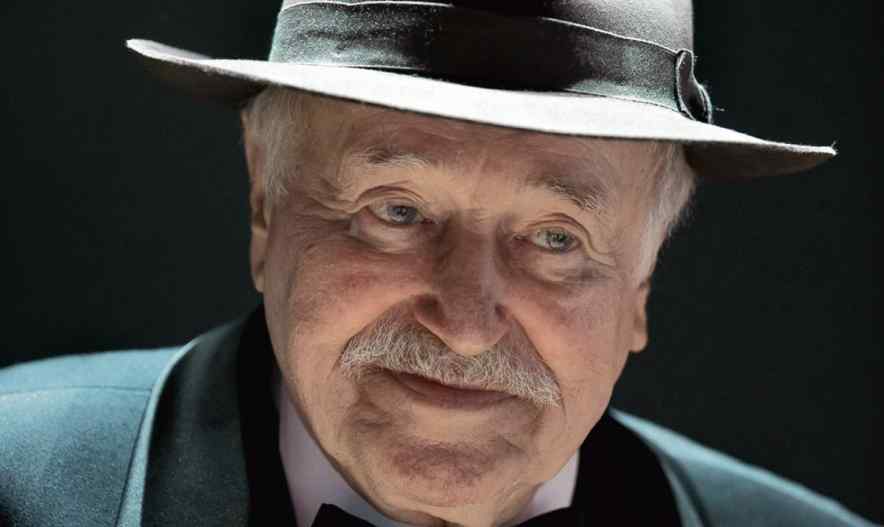
interview with an actor Jan Nowicki
interviewed by: Sylwester Kurowski
Translation: Zuzanna Czachowska
You have appeared in about two hundred film productions. Is there a recipe for being a good or credible actor?
I don’t know of any clear-cut recipe, because I think such thing doesn’t exist. Even an amateur can create a credible character, provided that it is based on a properly written script managed by a professional director.
Do you have time to read books? If so, do you find the classics interesting, or perhaps something more contemporary? Do you have any favorite authors?
Do I have time to read books? Krzysztof Zanussi says that it’s not us who have time, but time that has us. There’s something to that. However, I must admit that my current reading is in incredible disarray because I often forget having read a book and can practically start it all over again. I attribute this to an elderly ailment, which I accept with minimal embarrassment. I console myself with the phrase that people are divided into those who read and those who write. That doesn’t change the fact that everyone should read. Preferably the classics. Because I have the impression that the most important things were written long ago.
In your opinion, is there one outstanding book that everyone should read?
“The Idiot.” [by Fyodor Dostoevsky – editor’s note]
Is there a book that has influenced you and remains important to you over time?
There are a few, especially “The Tartar Steppe” by Dino Buzzati, “The Magic Mountain” by Thomas Mann, and “Demons” by Fyodor Dostoevsky.
Now that you have published several books, do you feel more like an actor or a writer?
I am preparing to publish my tenth book, titled “Happy Chaos,” in which – I hope – there will be more happiness than chaos. As for the second part of the question, I would say that I do not fully feel like either.
What does success mean to you?
Something like that – in the strict sense – simply does not exist. Creating is accompanied by a constant sense of incompleteness.
In the acting community, is friendship possible, or is it only about competition?
Of course, it’s possible. But even in friendship, especially among actors, you can notice an element of competition, which does not necessarily disrupt the friendship. [You can also notice – editor’s note] solidarity, which actors demonstrated, for example, by not appearing on television during martial law. Friendship is too serious a phenomenon to be confined to one profession. I had one friend in my life, Mr Piotr Skrzynecki, to whom I wrote letters even after his death. Today, those closest to my heart seem to be Marek Kondrat, Andrzej Grabowski, and Jerzy Trela. I mention these well-known names, but I also have other wonderful friends. Unfortunately, some have passed away because of the pandemic.
Was it easier in the past to be noticed by the audience, to make a name for yourself in the profession, or is it easier now?
Today, due to actors’ involvement in so-called “products for social consumption,” such as series, commercials, and talk shows, it is easier to be noticed by the audience. But is it really in the presence of a viewer who was once more demanding? The essence lies in the quality of the audience, not the actor. Being accepted by an undemanding audience means a lack of development, or even failure, for an actor, who usually does not realize it.
You acted in 20 films in Budapest. How was it working there? Were there any significant differences compared to working on film sets in Poland?
Poles make films, while Hungarians do them. That’s where I see their advantage. Hungarian films from the 70s and 80s were among the top of European cinema (Miklós Jancsó, István Szabó, Márta Mészáros, Ákos Kovács), and together with wonderful cinematographers, they created films awarded at festivals around the world. Hungarians, due to the hermetic nature of their language, achieved magnificent results in music and film. There was a time when I was sometimes taken for a Hungarian actor. By the way, I still consider my role as Imre Nagy in the film “The Unburied Man” by Márta Mészáros to be my greatest film achievement.
Kraków, Budapest, Kielce. Do you long for specific places, or do you feel great everywhere?
I don’t really long for places, but rather for people. In new places, I sometimes feel lost. Now my heart is where my wife is. The place doesn’t matter.
Is the Kowal of your childhood and the Kowal of today still the same town?
The Kowal of my childhood cannot be the Kowal of my old age. However, I try to look at the changes happening here with “those” eyes. Sometimes it works.
Is it easier for you to write or to perform? Can these two artistic forms be compared at all?
Nothing comes easily. But I think it’s harder for me to write. Because I still don’t know how. But that’s good. Doing what you don’t know how to do, in my opinion, makes you feel younger.
How did you meet Piotr Skrzynecki?
I met Piotr Skrzynecki at the end of the 1960s in Piwnica pod Baranami. I was just after my film debut in “The Ashes” by Andrzej Wajda. He dedicated a song to me. It was friendship at first sight.
What gives you more pleasure: watching movies, acting in them, or writing or reading books?
I have never been and never will be a film buff. Sometimes I don’t watch my own roles. As for books, I hope I haven’t written the best one yet. But I will try to write it. If time allows.
To write books, you need the nature of an introvert, while the acting profession requires extroversion. Is it possible to reconcile these two sides? Do they fight each other, or can they be tamed and start to cooperate?
Writing a poem, a story, or a song is a bit like acting on stage. But only in the case of great literature. I used to wake up in the middle of the night to remember my reaction or a situation on stage. Today, I sometimes write down a fragment of a dream, or even a whole sentence. Yes. An actor and a writer have something in common. What I would call creating your own idea of a character in acting, in writing becomes also observing it. Only with a pen. By the way, I still write with ink.
What is the origin of your books? After so many years of reciting other people’s, and therefore imitative, texts on stage and film sets, did your inner self want to be heard, as if in opposition to those alien words – a kind of antidote?
Every person, when dying, takes with them an unwritten book about themselves. An old person reaching for a pen often escapes loneliness and reveals a desire to talk to themselves.
With the De Profundis ensemble, you prepared “The Way of the Cross,” the program “From the Clouds to the Earth,” and “What One Man Can Do”. How do you collaborate? Do you find pleasure in joint performances?
That is already the past. Because of the pandemic. Twenty years of joint performances with the De Profundis ensemble was two decades of traveling the world with wonderful musicians: Marek Stryszowski – saxophone, vocals; Tomasz Kudyka – trumpet; Cezary Chmiel – keyboards; Tomasz Grochala – drums.
Traveling – exactly. Sometimes we forget about it. And yet, that is the deepest meaning of being an artist. Meeting people, cities, villages, churches. Besides, for me, listening to wonderful music, which I rank among the fine arts just after literature. And sometimes – even above it.
We know that, together with actor Julian Mere, you are involved in the project “Poems of the Master and Songs of the Apprentice”. Could you tell us something about it? Where did the idea for this kind of collaboration come from?
As with the De Profundis concerts – that’s already the past.
There wasn’t much of it. Maybe twice? The idea came from Julian.
We would have to work on this project more. Above all, it shouldn’t be too long. And with two soloists, it’s difficult. Besides, the audience should be left wanting more, not overwhelmed by the artist’s presence on stage.
Thank you for the conversation.